





What is Employment for Skill Development? (ESD)
The Employment for Skill Development system is a new program created not merely to secure foreign workers as “labor to resolve workforce shortages,” but to develop and secure them as mid- to long-term contributors who support Japanese society.
The existing Technical Intern Training Program has long been criticized for being difficult to understand.
In response, the government carried out a fundamental review of the system, deciding to abolish the Technical Intern Training Program and newly establish the Employment for Skill Development system.
The purpose of the Employment for Skill Development system is to have workers systematically acquire skills through employment, and to establish a framework that allows a smooth transition to the Specified Skilled Worker status after a set period.
Through this, the aim is to create an environment in which foreign workers can work stably in Japan and thrive over the long term.
The program is scheduled to take effect in April 2027, with the Technical Intern Training Program transitioning to the Employment for Skill Development system in stages.
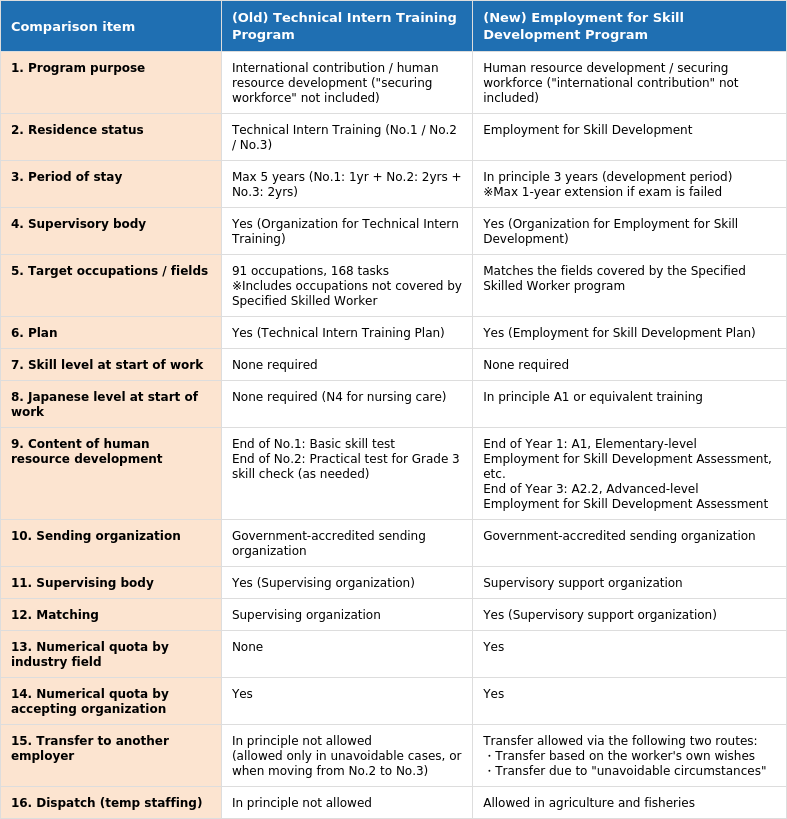
Major differences from the Technical Intern Training Program include: a program purpose that clearly positions human resource development and securing the workforce rather than “international contribution”; more flexible transfers between employers based on the worker’s own wishes; and clearer development plans that emphasize Japanese language ability and skill acquisition.
The Employment for Skill Development system is expected to be a more realistic and sustainable system for both companies and foreign workers.
1
Differences Between the Employment for Skill Development System and the Technical Intern Training Program
There is a major difference in purpose between the Employment for Skill Development system (new system) and the Technical Intern Training Program (current system) when it comes to why companies
2
About the Residence Status for Employment for Skill Development:
Language and Daily Life
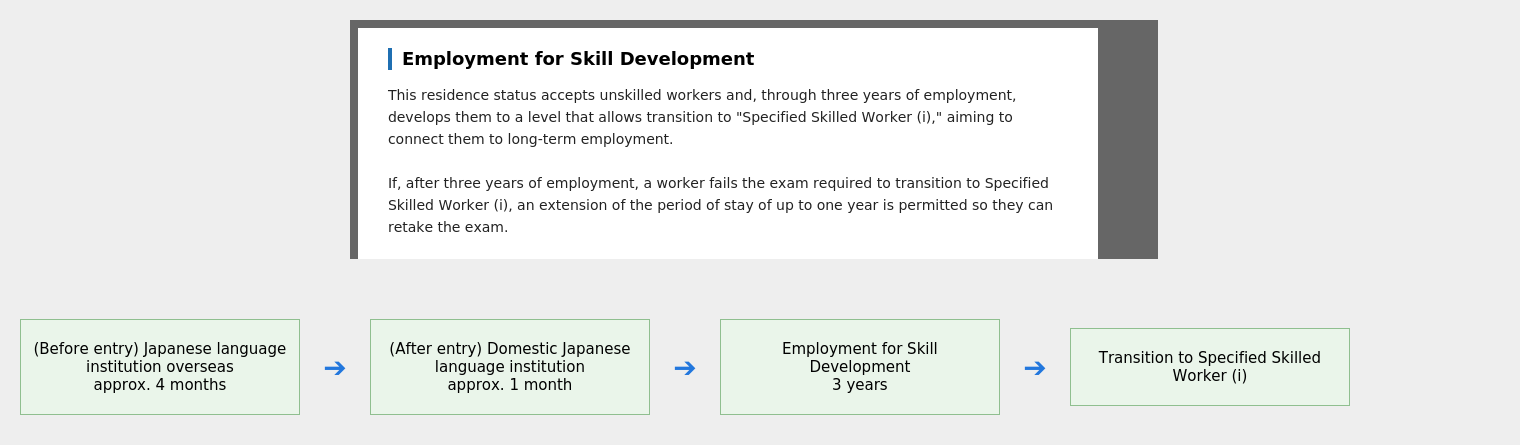
In principle, before coming to Japan, workers must pass the Japanese Language Proficiency Test “N5” in their home country or complete at least 110 hours of Japanese language training.
After entering Japan, they live for about one month at the union’s dormitory while attending Japanese language and other training.
After that, they are assigned to their respective companies.
Employment for Skill Development Acceptance Headcount Quota
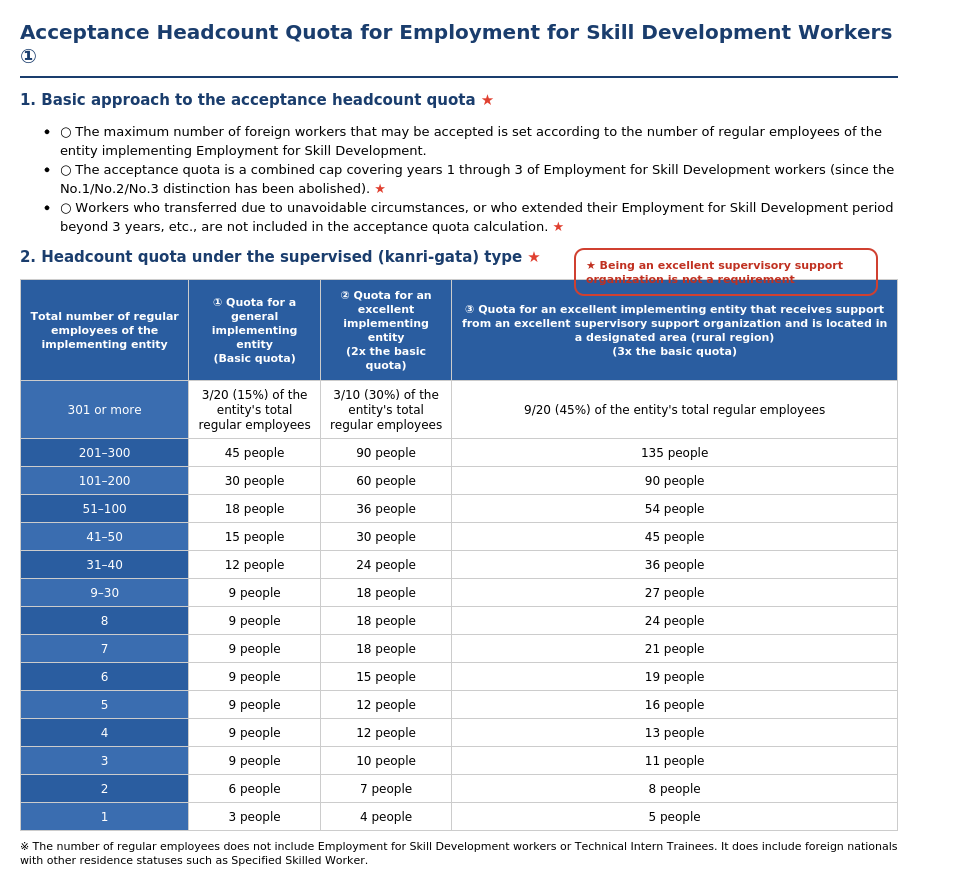
Workers who completed Employment for Skill Development and transitioned to Specified Skilled Worker status are removed from the acceptance quota count and included instead in the “number of regular employees
Requirements for Foreign Nationals Under Employment for Skill Development
- Must be 18 years of age or older.
- Must be in good health.
- Must be of good conduct (in the case of the supervised type, this is confirmed by the sending organization).
- Must hold a passport issued by a foreign government, etc., designated by the Minister of Justice as one that cooperates in the smooth execution of deportation orders.
- For those who have previously held Specified Skilled Worker status, they must be deemed suitable for Employment for Skill Development in light of the content of the work they performed as a Specified Skilled Worker.
- (For the independent type) Must be a regular employee who has worked for one year or more at the implementing entity’s overseas place of business, and who is being transferred or seconded from that place of business.
- (For the supervised type) Must be recommended by a public institution in their home country.
- (For the supervised type) In the case of an employee of an overseas place of business of a foreign public or private organization with which there is a close business relationship , must have worked at that overseas place of business for one year or more.
Treatment Requirements for Foreign Workers Under Employment for Skill Development
Implementing entities of Employment for Skill Development must comply with the following requirements regarding the treatment of these foreign workers.
- The amount of pay for the foreign worker must be equal to or greater than the amount paid to a Japanese national performing the same work.
- Treatment, including decisions on pay, must not be discriminatory on the grounds that the worker is a foreign national under Employment for Skill Development.
- If a foreign worker wishes to return home temporarily, they must be allowed to take the necessary paid leave.
- The implementing entity must take all of the following measures (in the case of the supervised type, the supervisory support organization may take these measures instead):
- Securing appropriate lodging facilities for the foreign worker.
- Taking measures, such as paying allowances, so that the foreign worker can focus on post-entry training.
- (For the supervised type) Ensuring that costs collected as supervisory support fees are not, directly or indirectly, charged to the foreign worker.
- If the transfer restriction period exceeds one year, working to improve treatment such as pay raises for the foreign worker, in accordance with the sector-specific operational policy.
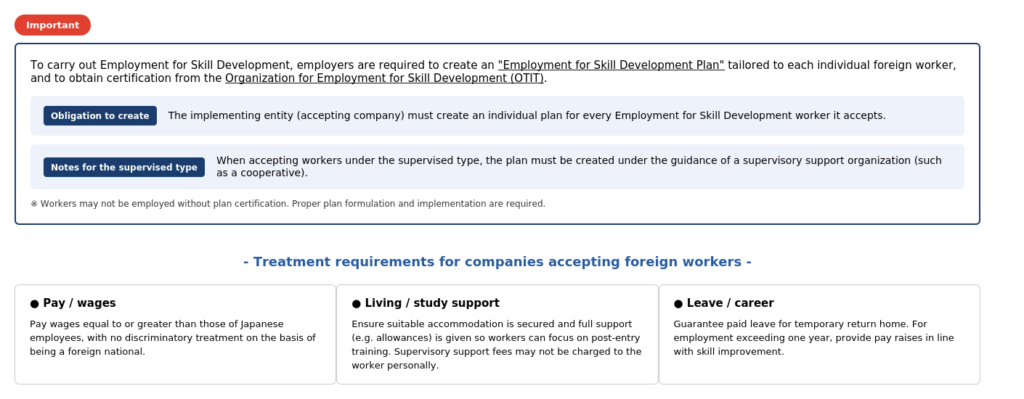
— On Certification of the Employment for Skill Development Plan —
Duration of Employment for Skill Development
The Employment for Skill Development period is three years, during which workers are developed to a level that allows transition to “Specified Skilled Worker (i).”
If, after completing three years of employment, a worker fails the exam required to transition to Specified Skilled Worker (i), an extension of the period is permitted as a special exception.
Acquiring Specified Skilled Worker status allows for long-term career development and settlement in Japan, unlike the previous Technical Intern Trainee system (which required return home after a maximum of 5 years).